


Conversion Optimisation for Tourism
Strategies to increase your direct bookings.

15+ years in the German market

Advice you can follow

Transparent pricing

Reporting in plain language
Hotel Online Marketing
Strategies for more direct bookings
Online marketing for hotels does not end with more website visitors. What matters is how many of those visitors become guests. This is where conversion optimisation starts: it improves every step of the booking process to increase direct bookings, without raising your advertising costs.
Targeted landing pages for tourism guide potential guests from their first point of interest straight through to booking.
More bookings without more traffic
Beispiel:
After optimisation:
Result: Double the bookings with the same traffic.
What conversion optimisation in tourism includes
AI systems now deliver concrete recommendations and sources instead of a classic list of search results.
Why conversion optimisation is so critical
Conversion optimisation does more than improve your direct booking rate. It simultaneously increases the efficiency of all your marketing channels: SEO traffic becomes more valuable, Google Ads achieve a lower cost per booking, and your share of direct bookings rises sustainably.
What you will learn in this guide
Conversion rate benchmarks by segment
In tourism, conversion rate means: website visitors who complete a booking or booking enquiry. The ranges are wide—depending on business type, traffic quality, and website condition.
Hotels (direct booking website)
Benchmark: 1.5–3.5%. Well-optimised hotels achieve 3–5%. Poorly performing hotels are below 1%.
Tour operators (packages/tours)
Benchmark: 0.5–2%. The complexity of booking (long lead times, high sums, group decisions) explains the lower rate.
Holiday rental providers (direct booking)
Benchmark: 2–5%. Direct booking platforms with strong review profiles achieve 4–6%.
Campsites (online reservation)
Benchmark: 3–7%. Spontaneous bookings and short decision paths explain the higher rate.
For comparison:
OTAs like Booking.com achieve a 10–15% conversion rate on their platform—because they have optimised for this exact purpose for years with million-euro budgets. The goal is not to beat Booking.com, but to gradually increase the direct booking share from a typical 15–20% to 30–40%.
The 3 killers of hotel/travel website conversion
Killer 1: A slow Internet Booking Engine (IBE)
The IBE is the most critical point in the entire booking funnel—and the most frequently neglected. According to an analysis by Travelport Digital (2024), half of all mobile users abandon an IBE with a loading time of more than 3 seconds. At 6 seconds, it’s 85%. Many hotels have modern Core Web Vitals on their website (LCP < 2.5 s)—but their embedded IBE loads in 6–10 seconds and destroys all previous optimisations. Common cause: Older IBE systems are technically outdated and not optimised for mobile-first users. Solution: Change the IBE system or implement an API-based native IBE integration on your own website.
Killer 2: Missing social proof at the booking moment
Users initiating a booking are in a phase of purchase doubt. At this moment, social proof decides: reviews, booking confirmations from others (‘3 people are looking at this room right now’), trust seals, and concrete references. Most hotel websites show social proof on the homepage and room pages—but no longer in the IBE itself. This is a serious mistake.
Specially optimised landing pages for tourism can also significantly increase the conversion rate.
Killer 3: Unclear pricing and missing direct booking advantages
Users who know your business still compare on Booking.com—because they look for the ‘real’ price there. If your direct booking page shows the same price or even a higher price than OTAs (parity problem), you have lost the direct booking argument. The solution: Communicate explicit direct booking advantages (best-price guarantee, free early check-in, welcome drink, flexible cancellation)—prominently on every page in the booking funnel.
UX principles for booking pages
Booking pages in tourism follow different UX rules than informational pages. The goal is not dwell time or scroll depth—but a single goal: complete the booking. Anything that distracts from this goal is a conversion killer.
Find more best practices in our guide to UX optimisation for booking pages.
Clear primary CTA:
‘Book now’, ‘Check availability’, or ‘Reserve room’—unambiguous, high-contrast, above the fold. A/B tests show: ‘Book now’ outperforms ‘Learn more’ by 23–45% in a direct booking context.
Scarcity and urgency:
‘Only 2 rooms left’, ‘Offer ends in 48 hours’—FOMO (Fear of Missing Out) doubles the conversion rate in lab tests. Only use if true—fake scarcity destroys trust.
Visual quality:
Professional room photos directly in the IBE—not just on the website. Users who see photos in the IBE convert 28% more often (Booking.com internal study, cited in Hospitality.net 2023).
Social proof at the booking moment:
Embedded review stars, recent bookings (‘3 nights were just booked’), TripAdvisor seal.
Trust signals:
SSL seal, payment logos, GDPR compliance communicated visibly—especially at the credit card query stage.
Progress indicator:
Visualise booking steps (‘Step 2 of 3’)—reduces abandonment rate by 15–20%.
IBE optimisation—the black box of direct booking conversion
The Internet Booking Engine (IBE) is the most important and most frequently underestimated component of digital hotel sales. While hotels invest thousands of euros in website design, their IBE often runs on a system from 2015—with poor mobile display, long loading times, and confusing booking steps. IBE optimisation is therefore the single biggest conversion lever for most hotels. Detailed information on IBE systems, typical errors, and optimisation strategies can be found on our dedicated page for IBE optimisation.
Critical IBE metrics you need to know:
IBE entry rate:
What percentage of website visitors even open the IBE? Target: 15–25%.
Completion rate:
What percentage of IBE starters completes the booking? Target: 20–35%.
IBE loading time:
Initial response time, calendar load time, step-to-step transition—all under 2 seconds.
Mobile IBE rate:
Percentage of IBE visitors on mobile devices—typically 60–70%, optimisation for this is mandatory.
A detailed overview can be found in our article on IBE optimisation for tourism businesses.
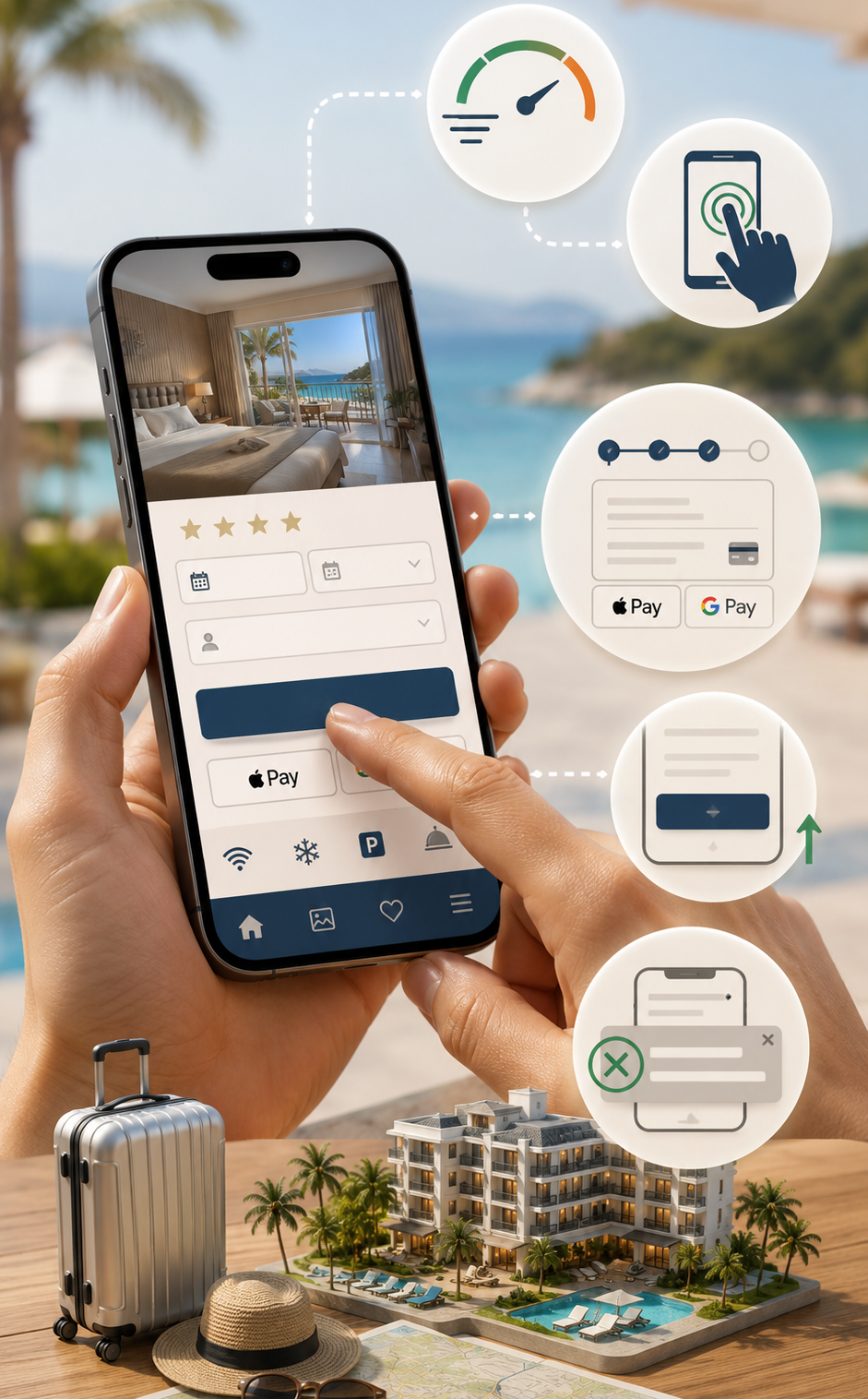
Mobile-first in tourism (60%+ of all searches are mobile)
According to Google Travel Insights (2025), 62% of all travel research happens on mobile devices. The critical difference: research is done on mobile, booking is still often done on desktop—but this trend is reversing. For spontaneous bookings (last minute, campsites, weekend trips), the mobile booking rate is already over 50%.
This is why a mobile-first approach for tourism is a central requirement for a fast and user-friendly booking experience.
Mobile-first requirements for tourism booking pages:
A practical example: A 4-star hotel in Munich reduced its mobile checkout from 7 to 4 steps and integrated Apple Pay. Result: Mobile conversion rate rose from 0.8% to 2.1%—an increase of 162% with unchanged traffic.


Communicating direct booking advantages—what really works
The best-price guarantee is the most important and simultaneously legally complex measure. You promise that the direct booking is never more expensive than any other booking source—and you refund the difference plus a bonus. Legally: In Germany, the parity clause (OTAs may not force hotels to offer the same or lower price on their platform) is effectively prohibited after a 2021 Federal Court of Justice ruling—hotels have the freedom to set cheaper direct prices. The following direct booking advantages have the highest conversion impact (ranking by user preference, Source: Phocuswire Survey 2024):
Recommendation: Communicate at least 3 direct booking advantages prominently on every page—header banner, room pages, IBE start page, booking confirmation. Not as running text, but as a visually highlighted bullet list with icons.
Further topics
Deepen your knowledge on central topics around conversion optimisation and direct bookings in tourism.
References


FAQ
Conversion optimisation in tourism
What is a good conversion rate for a hotel direct booking website?
A conversion rate of 1.5–2% is the market average, 2.5–3.5% is considered good, over 4% is excellent. Many hotels Argo.berlin has worked with started below 1% and reached 2.5–3.5% after 6–12 months of conversion optimisation. Important: The absolute conversion rate is less meaningful than the development over time—and the comparison with your own historical benchmark.
How do I correctly measure my hotel website’s conversion rate?
Set up a conversion event in Google Analytics 4 for completed bookings—not for IBE calls. Track via GTM and IBE confirmation page event. Important: Separate brand traffic (users searching directly for your hotel) from non-brand traffic (generic search queries). Brand traffic typically converts 5–8x better and distorts the overall rate.
Is A/B testing for booking pages really worthwhile?
Yes—but only with a minimum traffic of approx. 3,000 visitors per month (per test variant) for results to be statistically significant. Below this threshold: focus on best practices instead of tests. For smaller hotels, we recommend multivariate optimisations based on heatmaps (e.g., Hotjar) and session recordings, which make concrete abandonment points visible—without a statistical apparatus.
What impact does loading time have on the booking rate?
Every second of loading time over 2 seconds costs tourism businesses approx. 7–12% of potential conversions (Google/Deloitte study: ‘Milliseconds Make Millions’, 2020). A hotel with 3,000 monthly website visitors, a 2% conversion rate (= 60 bookings), and an average price of 150 € loses approx. 4–8 bookings per month if LCP worsens from 2 to 4 seconds—that’s 600–1,200 € monthly revenue loss due to loading time alone.
What should the direct booking share be for a hotel?
The industry-standard direct booking share for independent hotels is 15–25%. Well-optimised direct booking strategies achieve 35–50%. Every additional percentage point means less OTA commission (Booking.com: 15–18%, Expedia: 15–25%). With 100 monthly bookings and an average price of 150 €, increasing the direct booking share from 20 to 30% saves around 2,250 € monthly in OTA commissions.
Ready for more visibility and direct bookings?
Let’s develop the right strategy for your tourism business together.

Your partner for digital growth.
We develop data-driven strategies for measurable results.


