
Study · published 29 October 2026 · Authors: Roman Lange and Dietmar Fischer
Tourism Visibility Matrix DACH
Who is visible in which phase of the travel decision: in ads, in organic results and in Google’s AI answer. German-language searches in Germany, Austria and Switzerland, measured in September 2026.
Key findings
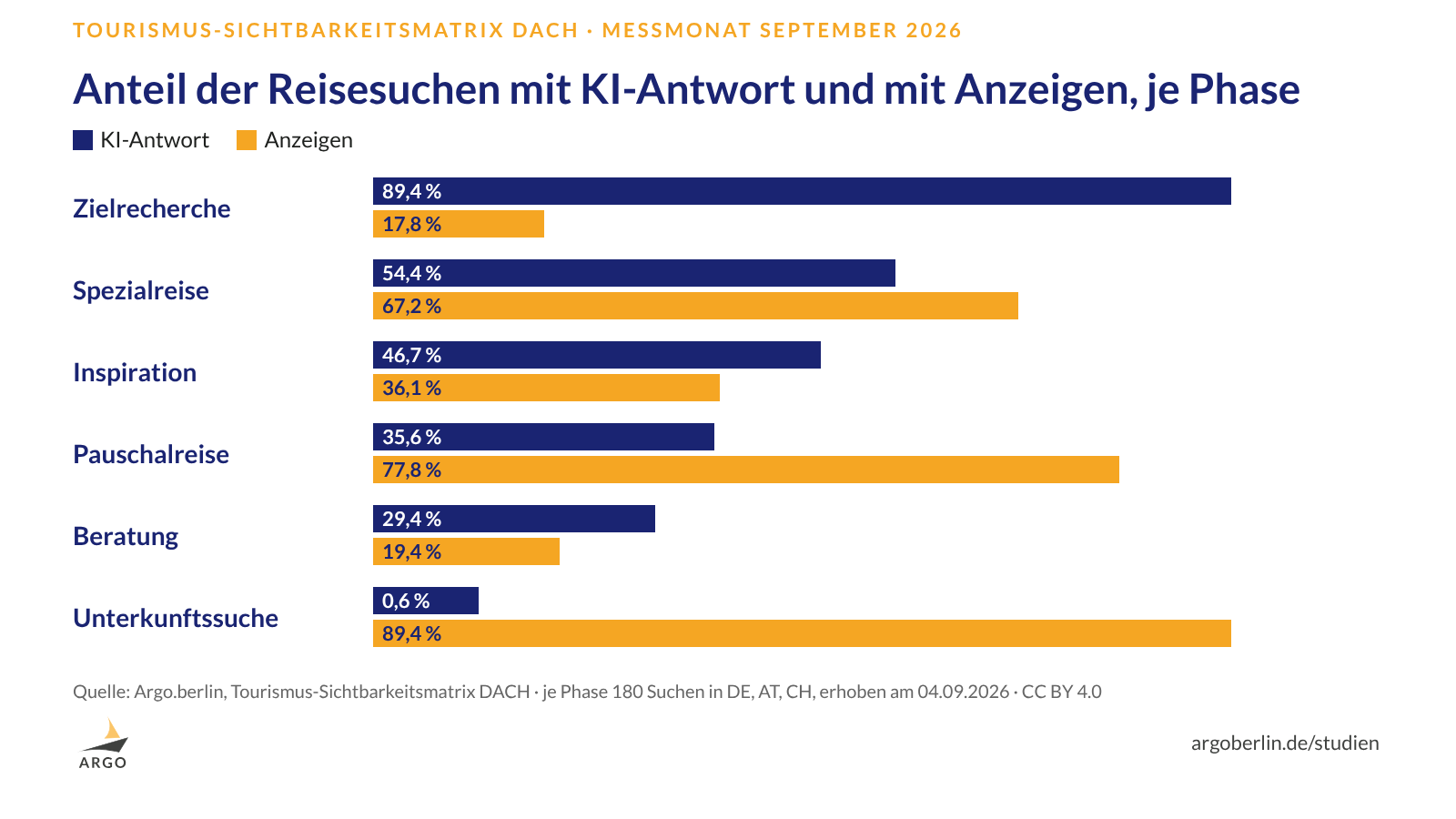
- Google splits the travel funnel in two: in destination research, 89.4 percent of searches show an AI answer and 17.8 percent show ads; in accommodation searches it is exactly the other way round, at 0.6 and 89.4 percent.
- 37.8 percent of the sources Google cites in travel AI answers are not among the organic results of the same search. In the inspiration phase the figure is 46.9 percent.
- In accommodation searches, independent hotels appear in 11.1 percent of organic result lists, in 6.7 percent of ad blocks and in no AI answer. Booking platforms appear in 99.4 and 86.7 percent.
- The AI answer cites content: editorial sources account for 31.1 percent of citations but only 0.8 percent of ads. The most cited single source is YouTube with 13.5 percent.
- In Germany, Google shows an AI answer for 52.5 percent of travel searches, in Austria for 40.0 and in Switzerland for 35.6 percent.
Share of travel searches with an AI answer, by phase
Source: Argo.berlin, Tourism Visibility Matrix DACH, September 2026; 180 searches per phase in DE, AT and CH · Licence CC BY 4.0
How we measured
360 German-language travel searches from six phases of the travel decision, 60 each: inspiration, destination research, accommodation search, package holidays, special-interest travel, and advice and problem cases. Collected on 4 September 2026 in Germany, Austria and Switzerland: 1,080 result pages in total, without location or personalisation. On every page, ads, organic results and the sources of the AI answer were recorded at the same time, and every domain was assigned to one of twelve provider types.
Limitations: A single measurement is not a time series. The query set maps the travel decision in a structured way but is not a sample weighted by search volume. Searches were run without a location, so local searches are under-represented. Provider types were assigned automatically and checked by sampling.
The full methodology with all counting rules is in the study (German).
Quotes
“Whether investing in AI visibility pays off depends on the phase of the travel decision in which your own guests are searching. For a destination, it is the key question. For a city hotel whose guests are looking for a room, there is currently nothing to gain there. The problem lies one level earlier, with the platforms.”
Dietmar Fischer, Managing Director of Argo.berlin
Downloads
- Press release (English)PDF 38 KB
- Press release (English)Word 37 KB
- Full study with detailed methodology (German)PDF 243 KB
- Dataset: visibility matrix market × phase × level × provider typeCSV 65 KB
- Dataset: segment analyses for hotels, travel agencies, booking platforms, tour operatorsCSV 6 KB
- Complete dataset with metadataJSON 228 KB
- Query set with phase assignmentJSON 62 KB
- Chart: AI answers by phase (German labels)PNG 134 KB
- Press photo Roman LangeJPG
- Press photo Dietmar FischerJPG
- Playbook for hotels and destinations: Where German-speaking travellers searchPDF free, by email

Suggested citation
You may use the datasets and charts freely under CC BY 4.0. Please credit Argo.berlin as the source and link to this page.
Article draft in the style of your publication
Tell us your publication, your name or initials and the length you need. An AI reads a few published articles from your publication and, if it finds any, articles by you. It then writes an English draft about this study. All figures come from the study and are automatically checked against it before the draft is shown. The draft appears on this page after one to two minutes.
We only adopt the style of an individual author if your email address matches the publication’s domain or you link to an article of your own. Otherwise the draft follows the style of the publication.
Contacts
Roman Lange
Roman Lange founded Argo.berlin in 2016 and runs the agency as managing director. He advises hotels, tourism boards, SMEs and non-profit organisations on Google Ads, search engine optimisation and media planning. His clients include Visit Berlin. He built the travel portals 1001TravelTips and Findadive and teaches digital marketing at adult education providers.

Dietmar Fischer
Dietmar Fischer is managing director of Argo.berlin and has worked in marketing and digital marketing for more than 20 years. Since 2003 he has taught marketing, digital marketing and entrepreneurship at universities in Berlin, Potsdam and Havana. He hosts the podcasts “A Beginner’s Guide to AI” and TOM, a podcast on tourism and online marketing.
Press contact: Roman Lange · +49 30 447 146 88 · roman.lange@argo.berlin · We answer in English and German.